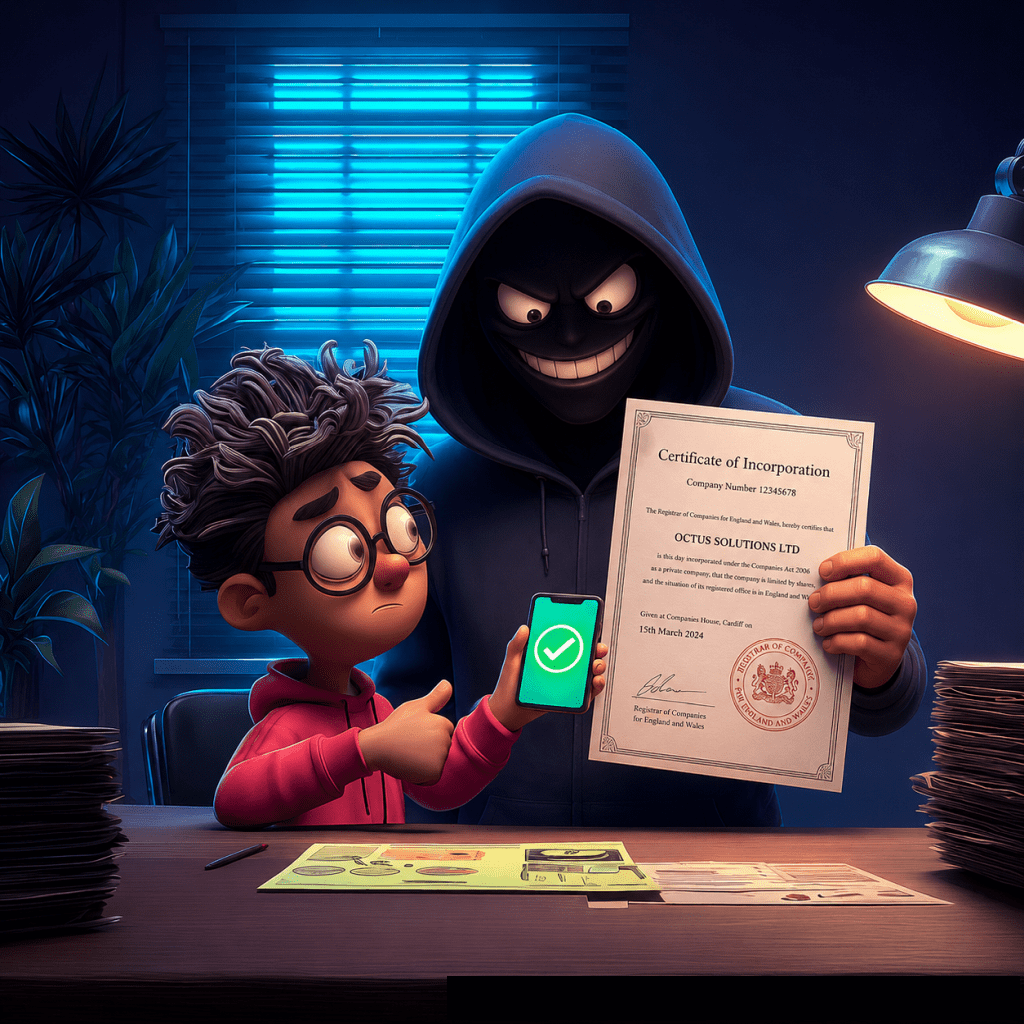
The diploma looked official. The employer contacted the verification service, and the qualification was confirmed. One problem: the diploma mill supplied both the degree and the service that "verified" it. The FTC has warned employers about exactly this setup.[ref]
Fake documents are not new. What changed is the cost, speed, and quality of producing them. Editing software, reusable templates, stolen genuine documents, and generative AI help criminals create and alter evidence at scale.
Within the millions of remote identity checks processed through Entrust's Onfido service, digital forgeries represented 57% of detected document fraud in its 2024 reporting period, up 244% year over year.[ref] That is vendor-network data, not a measure of every fraudulent document worldwide, but the direction is hard to ignore.
How fraudsters turn documents into false evidence:
💰 Loan and credit applications - Criminals submit false payslips, earnings records, tax forms, and bank statements to inflate income, employment, and assets. A documented U.S. case involved more than $140,000 in loan applications supported by false bank and earnings statements.[ref]
🏠 Rental fraud - Manipulated pay records and bank statements make applicants appear to meet affordability requirements. Snappt reported fraudulent material in 6.4% of rental applications represented in its 2024 analysis of nearly five million documents, including more than 80,000 manipulated files.[ref]
🧾 Receipts and claims - Fabricated receipts support false expense, refund, warranty, and insurance claims. Within days of GPT-4o image generation launching in 2025, public demonstrations produced realistic restaurant receipts; some still contained detectable errors, but the barrier to creating them had dropped sharply.[ref]
📑 Invoices and vendor onboarding - Forged invoices redirect payments or support fictitious purchases. Fake registration, insurance, tax, and ownership documents help criminals establish ghost vendors or impersonate legitimate suppliers.
🪪 Identity and supporting evidence - Counterfeit IDs, altered proof of address, employment letters, and financial records build a coherent-looking application. Each document reinforces the others, even when the entire profile is false.
🎓 Credentials with their own backup story - Diploma mills sell degrees, transcripts, invented accreditation, and verification services that confirm the bogus qualification. Fraudsters do not stop at forging the evidence; they manufacture the institution behind it.[ref]
The uncomfortable truth is not that visual inspection is useless. It is that appearance alone never proves authenticity. A document is a claim, and every logo, stamp, signature, QR code, phone number, and verification link printed on it remains part of that claim until checked independently.
What to do:
For organizations:
- Verify information with the authoritative issuer or an approved independent data source. Use independently sourced contact details, not those printed on the submitted document.
- Where lawful and proportionate, compare supplied documents with direct payroll, tax, banking, registry, licensing, or credential data.
- Use document forensics and consistency checks as risk signals: metadata, editing traces, fonts, compression, calculations, templates, identity links, and repeated devices or accounts.
- Validate secure digital signatures and issuer records where available. A decorative QR code is not the same as cryptographic proof.
- Investigate the complete application. A clean-looking document does not cancel contradictory identity, device, behavioral, or transaction signals.
For individuals:
- Verify unexpected invoices, guarantees, qualifications, and financial evidence with the organization that supposedly issued them.
- Reach the issuer through an independently found website or telephone number. Do not let the document choose the channel used to prove itself.
- Share identity and financial documents only when necessary and through trusted channels; genuine copies also become raw material for later fraud.
This topic came from a reader question after the Deepfakes post - thank you, and keep them coming!
The document looked flawless. Verification asks who stands behind it.